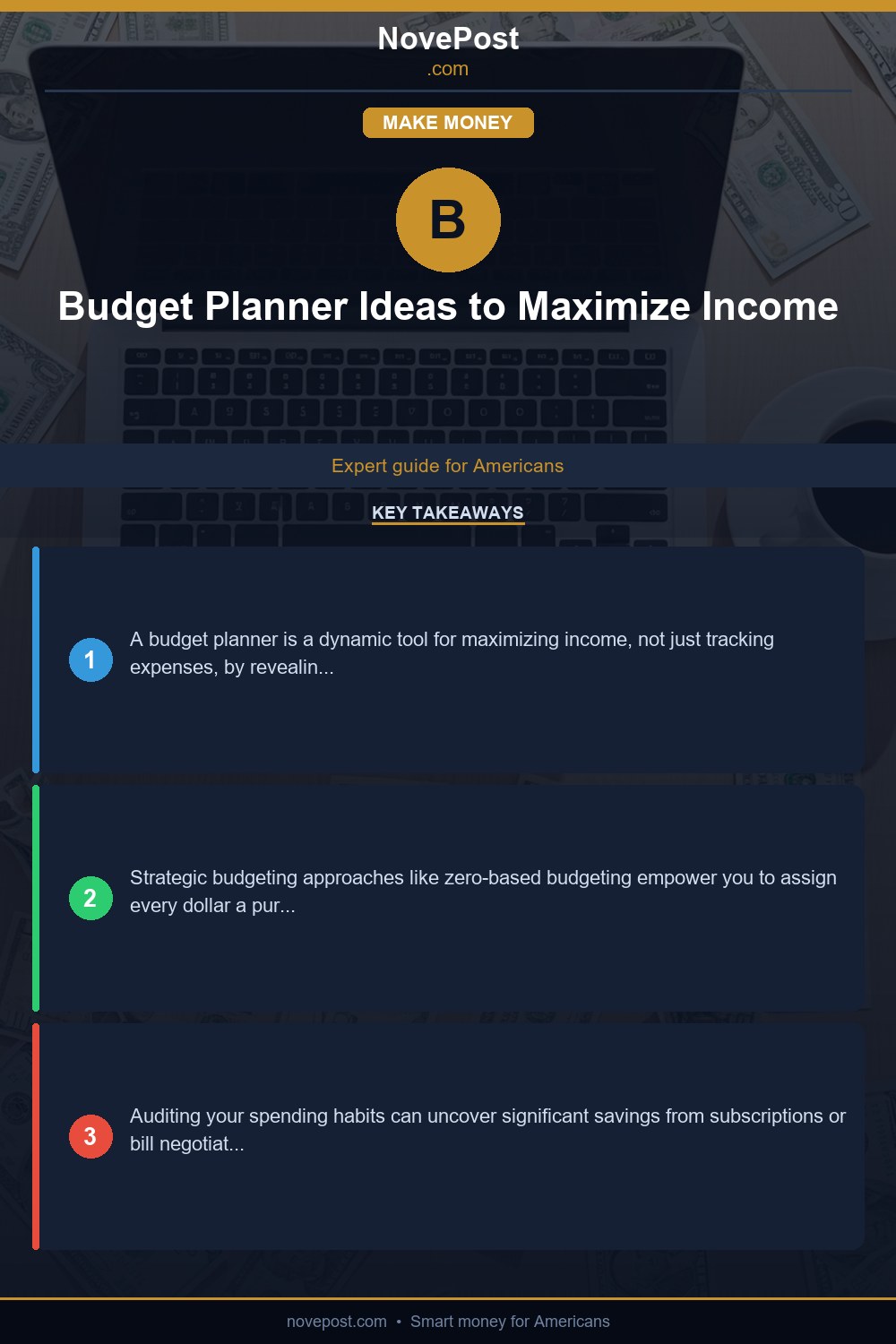
For many, the word "budget" conjures images of restriction, sacrifice, and endless spreadsheets tracking every penny. It's often seen as a necessary evil, a financial straitjacket designed to curb spending. But what if we told you that your budget planner isn't merely a restrictive ledger, but rather a powerful, dynamic tool capable of doing far more than just managing your outflows? What if it could become your personal blueprint for actively generating new income and accelerating your wealth accumulation?
For American adults aged 25-45, navigating student loans, rising housing costs, and the desire to build a secure future, traditional budgeting often falls short. This article will transform your perception of budgeting, reframing it as an offensive strategy for income maximization. We'll explore actionable budget planner income ideas that empower you to identify hidden financial opportunities, leverage your assets, and strategically invest in yourself and your future.
Redefining Your Budget: A Blueprint for Growth
The conventional wisdom of budgeting focuses heavily on expense reduction. While crucial, this approach only addresses one side of the financial equation. To truly maximize your income, your budget needs to evolve from a defensive mechanism into an offensive growth strategy. It's about consciously designing your financial life to create more, not just spend less.
The Strategic Budget: More Than Just Tracking
An active, strategic budget doesn't just record where your money went; it dictates where your money should go to achieve your income goals. It's a forward-looking document that helps you make informed decisions about resource allocation. Think of it as a business plan for your personal finances, where you are the CEO, and your income is the top-line revenue you're constantly striving to grow.
This approach helps you identify not only where you can cut unnecessary expenses but, more importantly, where you can strategically invest time, effort, or a small amount of capital to generate greater returns. It's about seeing your finances as a system where every component can be optimized for growth.
Embracing the Zero-Based Budget (or a Similar Strategic Approach)
One of the most powerful budget planner income ideas comes from the corporate world: zero-based budgeting. In personal finance, this means every dollar you earn is assigned a job – whether it's for bills, savings, debt repayment, investment, or even fun. The goal is for your income minus your expenses, savings, and investments to equal zero. This method forces you to be intentional with every dollar and can dramatically reveal funds that are currently being wasted or underutilized.
Actionable Step: Try implementing a zero-based budget for just one month. Categorize every dollar. You'll likely discover that you have more "free" money than you thought, which can then be redirected toward income-generating activities or investments. For example, if you find an extra $150 that was previously unaccounted for, that's $150 you can now invest in a high-yield savings account, a low-cost index fund, or even a course to boost your career prospects.
Unearthing Hidden Income Opportunities with Your Budget Planner
Your budget planner is an archaeological tool, capable of unearthing hidden financial resources that can be transformed into new income streams. This involves a deep dive into both your spending habits and your personal assets.
Auditing Your Spending for Surplus Capital
Before you can generate new income, it's often wise to stop the "leakage" of existing funds. A detailed budget review helps you identify areas where money is being spent inefficiently, which can then be redirected. The average American spends approximately $219 per month on subscription services they may not fully utilize. That's over $2,600 annually!
- Subscription Purge: Go through all recurring charges. Cancel unused streaming services, apps, or gym memberships. Even cutting just two $15 subscriptions frees up $30 monthly.
- Negotiate Bills: Use your budget to see how much you spend on internet, cable, and insurance. Many providers will lower your rates if you call and ask, especially if you mention competitor offers. This simple act can often save you $50-$100 per month without changing providers.
- Optimize Groceries & Dining: Meal planning and cooking at home more often, along with mindful grocery shopping, can significantly reduce your food budget. If you typically spend $600/month on food, a 15% reduction means an extra $90 monthly for other purposes.
Once you've identified these surpluses, don't just let them sit. Reallocate them directly into an income-generating or wealth-building activity.
Monetizing Your Skills and Hobbies
Your budget planner can also help you identify available time slots – evenings, weekends – that can be used to develop a side hustle. What skills do you possess that others would pay for? What hobbies could be turned into a small business?
- Freelancing: If you have skills in writing, graphic design, web development, social media management, or virtual assistance, platforms like Upwork, Fiverr, or LinkedIn can connect you with clients. Earning an extra $300-$500 per month from a few hours a week is highly achievable.
- Gig Economy: Driving for rideshare apps (Uber, Lyft), delivering food (DoorDash, Uber Eats), or offering services through TaskRabbit can provide flexible income.
- Teaching/Tutoring: Share your expertise in a subject or skill. Online platforms or local community centers are great places to start.
- Creative Pursuits: Selling handmade crafts on Etsy, photography, or even running a small blog with affiliate marketing can generate passive or active income over time.
Leveraging Existing Assets
Look around your home. Do you have underutilized assets that could be generating income?
- Rent a Spare Room: If you have an extra bedroom, consider listing it on Airbnb. Depending on your location, a private room can generate an average of $900+ per month in major cities, significantly offsetting your housing costs.
- Sell Unused Items: Decluttering your home can literally put cash in your pocket. Use platforms like eBay, Facebook Marketplace, or local consignment shops. Many people find they can easily earn $100-$500 by selling clothes, electronics, furniture, or collectibles they no longer need.
- Rent Your Car: If you don't use your car daily, services like Turo allow you to rent it out, potentially earning several hundred dollars a month.
Strategic Investment: Making Your Money Work Harder
Maximizing income isn't just about earning more actively; it's also about making your money work harder for you. Your budget planner is crucial for identifying the capital available for strategic investments.
Automating Savings and Investments
Once you've identified surplus funds through your budget audit and side hustles, the next step is to automate their allocation. Set up automatic transfers from your checking account to a dedicated savings or investment account immediately after you get paid. This "pay yourself first" strategy ensures that your income-generating efforts translate into long-term wealth.
Actionable Step: Aim to automatically save and invest at least 10-15% of your gross income. If your budget reveals you can push this to 20% or more, do it. Consistency is key here.
Diversifying Income Streams through Smart Investments
Beyond traditional employment, smart investments are powerful budget planner income ideas that build passive income and grow your wealth over time.
- Low-Cost Index Funds/ETFs: These provide broad market exposure and diversification with minimal effort. Historically, the S&P 500 has averaged returns of 7-10% annually after inflation. Even investing just $200 per month consistently can grow substantially over decades due to compounding.
- High-Yield Savings Accounts (HYSAs): While not high-growth, HYSAs offer significantly better returns than traditional savings accounts (often 4-5% APY), providing a safe place for your emergency fund or short-term savings to earn a respectable return.
- Real Estate Investment Trusts (REITs): For those interested in real estate without the hassle of property ownership, REITs allow you to invest in portfolios of income-generating properties and often pay strong dividends.
- Dividend Stocks: Investing in companies that consistently pay dividends can create a steady stream of passive income, which can then be reinvested to accelerate growth.
Upskilling and Career Advancement
One of the most effective ways to maximize your primary income is to invest in yourself. Your budget planner should include a line item for professional development. This could be:
- Online Courses/Certifications: Acquire new skills that are in demand in your industry. For example, a certification in project management or data analytics can lead to a 5-10% salary increase in a relatively short period.
- Networking Events: Budget for attending industry conferences or workshops, which can open doors to new opportunities and higher-paying roles.
- Higher Education: While a larger investment, a master's degree or specialized qualification can significantly boost earning potential over the long term. Ensure your budget accounts for tuition, books, and living expenses if pursuing this path.
By treating professional development as an investment, your budget planner helps you allocate resources to increase your most valuable asset: your human capital.
Conclusion: Your Budget as a Catalyst for Wealth
The traditional view of budgeting is fundamentally flawed if it doesn't actively pursue income maximization. For American adults aged 25-45, a budget planner is not merely a financial guardian but a powerful catalyst for wealth creation. By implementing these budget planner income ideas – from meticulously auditing your spending to strategically monetizing your skills and making smart investments – you transform your financial outlook from one of scarcity to one of abundance.
Your journey to maximizing income begins with a shift in mindset: seeing every dollar as a potential seed for growth. Embrace the power of your budget planner to not just track, but to strategize, invest, and ultimately, build the financial future you envision.
Actionable Call to Action: Don't wait. Open your budget planner today – or create one if you haven't already – and identify just one area where you can cut unnecessary spending and one skill or asset you can monetize. Take the first step towards an income-maximized life.